Evolution
Influenza A viruses continuously undergo antigenic evolution. Since the viral surface glycoprotein HA is the antigen against which virus-neutralizing antibodies are directed, it is primarily the antigenic variation of HA that is responsible for the immune escape of influenza viruses. Two distinct mechanisms of antigenic evolution can be identified: antigenic drift causes regular influenza epidemics, while antigenic shift is the cause of occasional global outbreaks of influenza (pandemics). Antigenic drift is a gradual process and occurs as a result of the accumulation of point mutations in the epitopes of HA. Indeed, the replication of viral RNA is an error-prone process, leading to a mutation frequency of about one in 100,000 nucleotides. Considering that the size of the entire influenza virus genome is about 14,000 nucleotides, many new viral RNA genome copies will contain one or more mutations. Some of those may give rise to new virus variants with an advantage over the parent virus. Depending on the nature of the mutation, the new virus strain may still be partially recognized by the immune defence of the host. Thus, the severity of an epidemic is a subtle interplay between the waning immunity in the population, the extent of the antigenic drift and the virulence of the new virus variant.
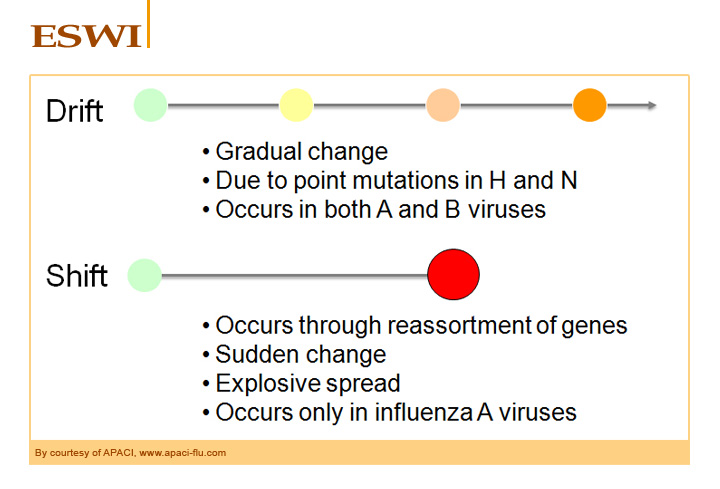
Antigenic shift and antigenic drift